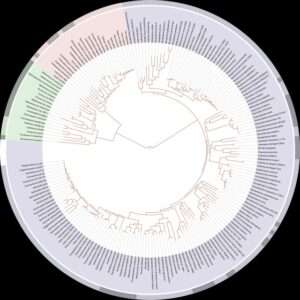
 Note: This post was inspired by a thought-provoking article by Kevin Omland.
There’s this misconception that if a species has traits that evolved earlier in the history of life on Earth, that it must be “primitive”, a “living fossil”. This hinges on the idea that newer adaptations must be more advanced than older ones, and newer species more highly evolved than their predecessors.
The problem with that is that life and evolution are not strictly linear; nature is much more cyclical. Think about all the various geological forces that have been at play since before life even appeared. Tectonic plates have formed, broken apart, subducted under other plates and been melted back into the mantle. Mountains rise, then erode away, all the while having massive effects on the land around them. Rivers cut courses again, and again, and again, meandering across the landscape for many miles. The climate has warmed and cooled and warmed again (though not normally to the extreme amount we’re seeing today.)
All of these conditions and more have required life to adapt, sometimes in a relatively short period of time. And so we’ve seen species come and go; at times, entire genera, families, orders, even classes disappear into extinction. But every living being is the same distance from the first spark of life over three billion years ago, and every lineage alive today has survived changing conditions to be here now.
The arrogance of humanity, of course, is the belief that we are somehow more special than every other species. We tell ourselves stories in which we are the pinnacle of life, and every other being must bow down before us because obviously they are only there for us to use as we see fit. Even in evolutionary terms we are newcomers; the archaic Homo sapiens appeared a mere 300,000 years ago. Doesn’t that mean we are the shining end result of all that evolution?
Not really. Species come and go, and even as clever as we are, eventually we will likely cease to be, whether we evolve into other species in the future, or simply reach the dead end of total extinction. Sure, we have some pretty neat adaptations we’ve carried along from various primate ancestors–upright walking, an efficient cooling system, opposable thumbs, and a great big brain that allows us to tell those stories of how superior we supposedly are.
But life will continue, as will evolution. Mountains and tectonic plates and rivers will rise and fall, and the conditions of the planet will continue to change–and life with it. Even if we only have another billion years or so of life-supporting conditions on Earth ahead of us, that’s still plenty of time for things to happen. A large mammal species like humans might average a few million years on Earth before being supplanted or changing into something different; we haven’t even made it through our first half million yet.
Some might find that sad, to think of a world without us. I find it comforting, though, to know that we’re part of this incredible parade of a diversity of life that has continued to shift and change and adapt over billions of years, and which will continue in this incredible dance long after we’re gone. We burn brightly while we’re here–perhaps a little too brightly right now–and it’s debatable how positive our mark on this world is turning out to be.
But no one will be able to erase the fact that we were here, with our stories and songs, our communities and our inventions, and so, so much love and joy and connection. Even if our sort of self-awareness eventually dies out, it doesn’t make the present moment any less precious. If anything, it makes it moreso, because we know our time here is limited. So how shall we each spend our few decades here, as part of the handful of millennia that our species may enjoy?
I’m currently reading Dan Flores’ excellent book, Coyote America. The first chapter spends a great deal of time on indigenous American Coyote stories and what they say about both the land and the people here. This article reminds me of a poignant observation:
So it was Coyote who “made it law” (the Yanas said) that humans would have to die to create space for the generations down through time. When the first humans heard this, however, they resented it deeply. According to the Yanas, Coyote then came up with a second rationale for death, this time as the ultimate reason for appreciating being alive: “Well, you know, if you die, then you really have to take life seriously, you have to think about things more.” (Flores, p. 45)
I’ve spent a lot of time unlearning the idea that we’re the only special beings on the planet, that we can take our fellow beings for granted, and the tunnel vision only on the immediate and the now. I see us couched within a much longer, grander story, replacing the belief “we are the best” with the wonder and awe of “we are a part of something so much greater and more incredible than ourselves alone.” It enriches my life and gives it more meaning, and makes me appreciate the moments I have here even more.